
Who are we?
The Australian Right Whale Research program is an umbrella organisation
coordinating long-term research across multiple Southern Right Whale (Eubalaena australis)
breeding sites in South Australia.
We facilitate and manage collaborative studies between Australian and international partners, including universities, government departments, non-governmental organisations, Traditional Custodians, and citizen scientists.
Our coordinated research spans sites such as: Head of Bight, Fowlers Bay, Encounter Bay and other critical aggregation areas, enabling regional comparisons and large-scale assessments of population health and recovery.
OUR MISSION
Is to deliver world class long term research for the protection of endangered southern right whales, whilst sharing their story through science, community engagement, education and policy.


Our Current Research Goals
.png)
Our team has collaborated with the International Whaling Commission (IWC) to apply a standardized visual health assessment protocol. Led by Dr Emily Gregory, this global initiative involves collecting high-resolution photographic data—often via drones—at key breeding sites like Head of Bight. These assessments track body condition, visible injuries, and skin condition to evaluate individual and population health trends over time.
.png)
Emerging evidence suggests that climate-driven changes in the Southern Ocean, including shifts in prey availability and ocean temperature, may influence southern right whale growth, body condition, and calf survival. Our long-term datasets on reproductive rates, birth intervals, and calf size correlated with environmental oscillations support studies which identified climatic impact on reproductive output. These insights are crucial to understanding population resilience under climate stress.
.png)
Southern right whales are individually identified by unique callosity patterns around their head and jawline. Traditionally, this process relied on skilled human analysts reviewing thousands of cliff‑ and vessel‑based images, an invaluable but labor-intensive approach
Today, we’re exploring AI-driven photo-ID techniques (inspired by successful machine-learning methods used for other marine megafauna) to automate detection, matching, and flagging of unknown individuals. This innovation speeds up cataloguing, boosts accuracy, and unlocks new potential in inter-site matching across Australia and the wider Southern Hemisphere.
.png)
Our research contributes to the emerging Australian National Southern Right Whale Database, hosted via the Australian Right Whale Photo‑Identification Catalogue (AWRPIC). This unified platform aggregates citizen‑science submissions (e.g., Encounter Bay photos), field-collected imagery, and AI-analyzed records to support conservation and management decisions
By combining networks of aggregation sites such as Head of Bight, Fowlers Bay, Encounter Bay and standardised global protocols, this database enhances connectivity analyses, tracks individual life histories and movement patterns across hundreds of kilometres, and underpins national population assessments.
What our research has taught us so far
The Hottest 10 findings countdown

10
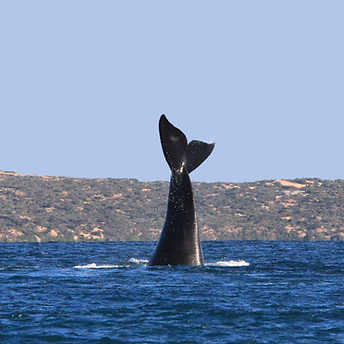
Southern right whales migrate to the Australian southern coast May-October to breed, rest and socialise

9
The are distributed across the Australian Marine park Network between WA and QLD

8
The Australian population is increasing at around 6% per annum, with recent signs of slowing

7
There is a two population model in Australia based on genetics and recovery: Eastern and Western population

6
Distribution ranges are expanding as primary calving grounds are reaching saturation capacity

5
The Australian southern right whale population is in good body condition

4
Increasing calving intervals are being observed, meaning a slowed recovery rate

3
Threats include entanglement, vessel disturbance, climate variability, noise interference and habitat modification

2
Increased whales and humans results in increased interaction and a greater need for effective management
1
Continued and developing updates to the commonwealth recovery plan and biologically important areas
Encounter Bay
Right Whale Study
Connecting the community, scientists and managers for Southern Right Whale protection, conservation and education


Encounter Bay, South Australia
Encounter Bay is listed as an 'emerging' calving aggregation area for southern right whales under the National Conservation Management Plan for the Southern Right Whale 2011-2021. An emerging status assumes less than 3 calves are born at or near Encounter Bay each year.Our data suggests an average of more than 3 calves per year are born in the Encounter Bay area, potentially suggesting an upgrade in status from and 'emerging' to an 'established' aggregation area and making Encounter Bay a critical area for protection and recovery of the species.
_edited.jpg)
Research
The Encounter Bay Right Whale Study (EBRWS) is a citizen science program designed to address research priorities that will inform conservation management and protection of the local southern right whales (SRW) by:Establishing a local Encounter Bay (EB) photo-identification catalogue.Contributing data to national SRW assessments.Investigating abundance, residency, distribution and movements of SRW in the EB area.Assessing the connectivity and movement of SRW from EB with the other calving/aggregation areas across South Australia.
How to Contribute
None of this work is possible without photographic evidence and clear sightings information. As a citizen science research study we are looking to the public to collect and provide good data. Photo-identification is a very important tool for assessing abundance, distribution, site use, residency, calving and migration rates, age of sexual maturity, survival and mortality. The goal is to get clear photos of the top and both sides of the whale's head.
See examples below:
Example 1 (Right Side) Example 2 (Left Side) Example 3 (Top)
If you think you have good identifying photos of a whale, please get in touch with the EBRWS team!


Contact EBRWS
If you think you have good identifying photos of a whale, please get in touch with the EBRWS team